
Painted by French muralist Mantra, these striking butterfly murals at One Burton celebrate the beauty and diversity of insect life. The mural is viewable from 2400 South, between Main and West Temple.
If you’ve exited westbound I-80 at State Street lately, you may have caught sight of a striking row of oversized butterflies seemingly pinned neatly across the facade of a new apartment building. Painted to look like a giant entomology display, the new mural at One Burton is hard to miss—and worth a closer look.
It’s the work of French artist and naturalist Youri Cansell, aka Mantra, who has made a name for himself painting astonishingly lifelike butterflies and moths on city walls around the globe. Driven by memories of his childhood garden in France, Mantra creates large-scale murals that are both scientifically accurate and visually spellbinding. He was in Utah last week for South Salt Lake’s 2025 Mural Fest when during which he created this mural, both beautiful and bittersweet—biodiversity is a recurring theme in the artist’s work.
You might find yourself asking, Are these butterflies real? And more intriguingly, are they local?
The short answer: yes, at least as far as we can tell, 15 Bytes not having a lepidopterist on staff.
Take the Cabbage White (bottom right), a pale-winged pollinator that may be flitting through your backyard right now. Originally from Europe, it’s now one of the most widespread butterflies in North America and a regular in Utah gardens. The Mourning Cloak, with its maroon wings edged in blue and yellow, is another familiar face here. One of the earliest butterflies to emerge in spring, it actually hibernates through the winter—something few butterflies do.


Center right the butterfly with bold black stripes and lemon-yellow wings appears to be the Tiger Swallowtail, which is technically an eastern species (Papilio glaucus), but its western cousin (Papilio rutulus) is a Utah native.
The bright blue and purple butterflies bottom left may be the Silvery Blue and Acmon Blue, both of which flutter through Utah’s meadows and foothills.
The large butterfly on the left of the mural is probably the Clouded Sulphur, which you may find congregating near puddles for the moisture. The one we’re struggling with the most is the brown and orange butterfly in the upper right of the mural. A Milbert’s Tortoiseshell, maybe?
Someone from a century ago might have less difficult of a time identifying these species. The mural’s scientific display format is a nod to the golden age of butterfly collecting in the late 19th and early 20th centuries, when naturalists and hobbyists were obsessed with capturing, pinning, and cataloging insects. While the practice has faded (with a shift toward photography and conservation, thankfully), this mural echoes that bygone era, where drawers of pinned specimens represented both scientific inquiry and a sense of wonder.

For identifications, we might have asked Nicole Parish, an American Fork artist whose work has been awarded in this year’s Spring Salon and purchased by the Springville Museum of Art. She is an autistic artist with a deep love of insects—an interest rooted in childhood days spent exploring the outdoors and raising butterflies, beetles, and praying mantises. Her detailed paintings are based on specimens from her own growing collection, which she preserves and references to create scientifically accurate works. “I like to paint the information I see as accurately as possible,” she explains, noting that her insects are painted to scale and with the same reverence one might bring to a scientific illustration. The museum used her painting for promotional work for this year’s Salon.
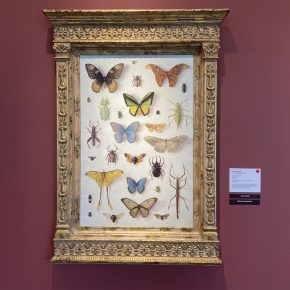
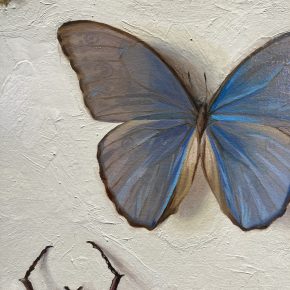

All images courtesy of Shawn Rossiter.

UTAH’S ART MAGAZINE SINCE 2001, 15 Bytes is published by Artists of Utah, a 501 (c) 3 non-profit organization headquartered in Salt Lake City, Utah.
Categories: Art Lake City | In Plain Site | Visual Arts