
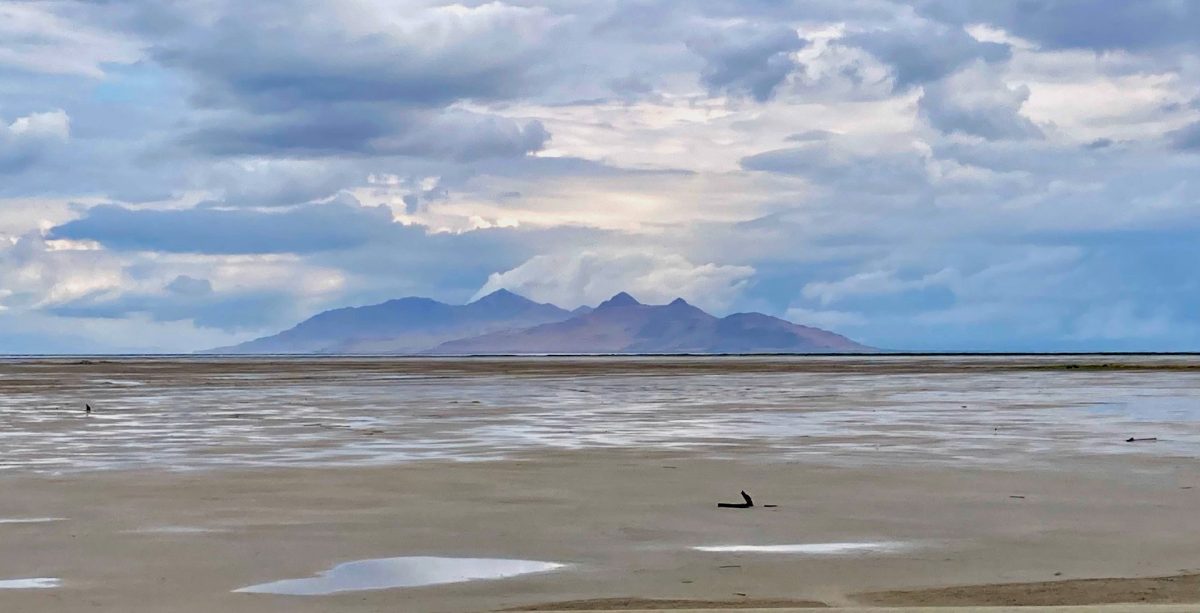
Storm clouds gather over the Great Salt Lake, where receding waters leave vast stretches of exposed lakebed, August 2025. Image by Shawn Rossiter.
“Monsoon season” has arrived, which is an odd phrase to write in a desert state, but particularly so during one of the hottest and driest summers on record. It’s the term we use for the mid-to-late summer weather cycle that brings sometimes intense afternoon thunderstorms. It typically runs from mid-July through September, but here it is, almost Labor Day, and the first storms have only just erupted this week. Though late, this week’s showers will surely help to ease worries about our lawns and trees. It might even help us forget about the Great Salt Lake.
A month ago, The Salt Lake Tribune published an article about the Salt Lake City Arts Council’s efforts to remember the lake. Last year, the Arts Council received its largest-ever grant—$1 million—from Bloomberg Philanthropies to raise awareness about the deteriorating Great Salt Lake through public art. The Wake the Great Salt Lake initiative is funding 12 diverse projects, each located in one of Salt Lake City’s seven districts and created by artists with ties to Utah. We have reported on several of these: the Great Salt Lake Hopeline, a pink phone booth that invited people to leave or listen to messages about the lake, focusing on hope and community connection; Mitsu Salmon’s nature-inspired dance performance, held at the Miller Bird Refuge, using bird sounds and interpretive dance to connect themes of human and bird migration; Kellie Bornhoft’s installation of fabric banners depicting 64 species dependent on the lake.
Just days after the Tribune ran their article on the Arts Council’s ongoing project, they published another one about the lake itself: it is once again approaching the historic lows reached in 2022. From this Spring, you may remember Grow the Flow’s digital billboard along I-15, which showed the Great Salt Lake’s current water level and where that level sits on a scale from “healthy” to “collapse.” In April, at 39.8%, it was hovering in the red, somewhere between critical and collapse. Since then, the lake has lost another three feet of water and you can expect to see it shrink further over the next couple of months. Things aren’t going so well.
One of Wake the Great Salt Lake’s funded projects was Nick Pedersen’s “Here Today, Gone Tomorrow.” On a busy corner in the Poplar Grove neighborhood of Salt Lake City, two contrasting billboards show digital collages depicting potential futures of the lake: one hopeful, the other apocalyptic. In May it was unveiled to much fanfare, including performances, art activities, previews of related projects, and comments from community leaders. Days later, we stopped by to photograph the installation. At the foot of the billboards, attracting most people’s attention was an impromptu market of shoes, electronics and household appliances—emblematic of the mundane forces art activism must compete with. Artists can be imaginative and conceptually rigorous and artworks aesthetically rich and politically relevant, but most people will continue to go about their daily lives. Grow the Flow’s billboard on I-15 has been replaced by advertisements for groceries, accounting help and college sports.
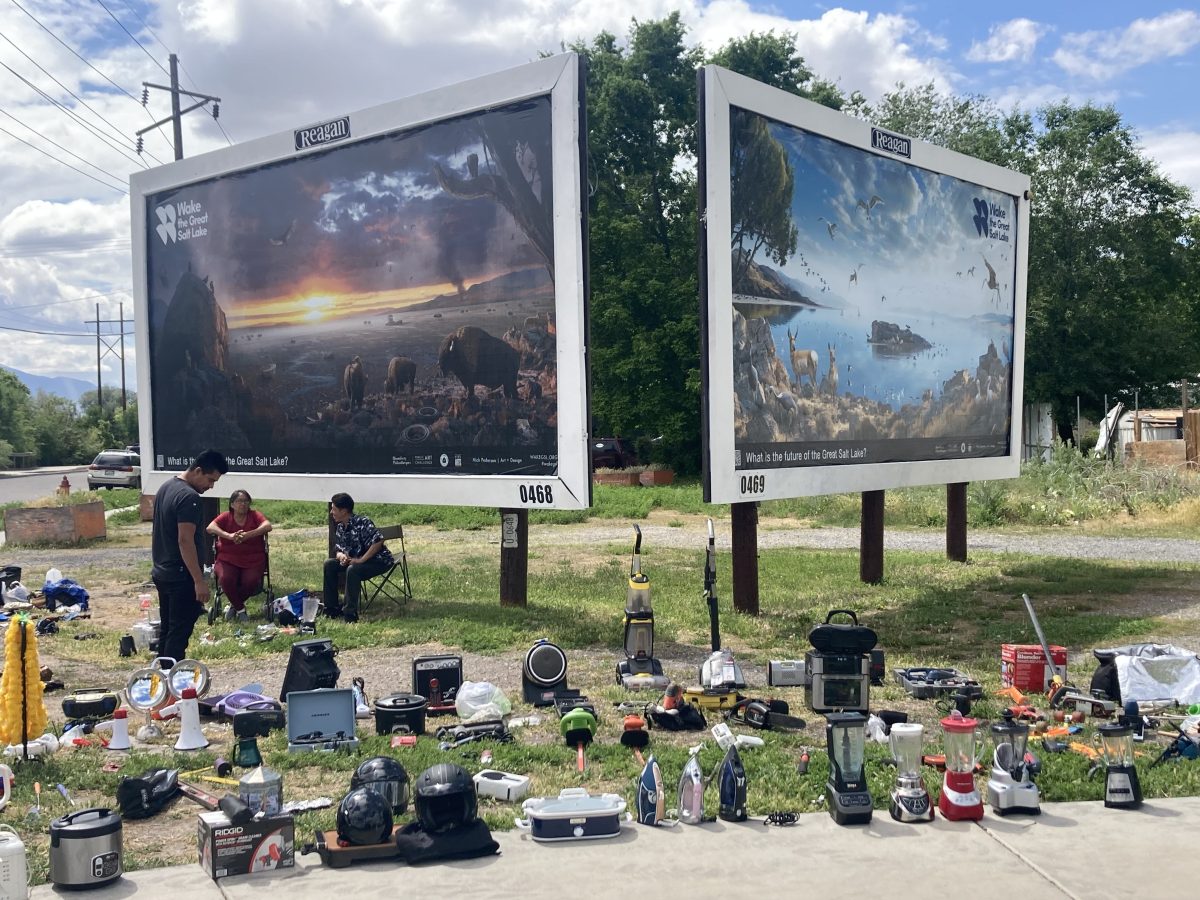
In May 2025, Nick Pedersen’s “Here Today, Gone Tomorrow” billboards present starkly contrasting futures of the Great Salt Lake—one hopeful, the other apocalyptic—while a makeshift market of household appliances unfolds below, a reminder of the everyday distractions that compete with art activism. Image by Shawn Rossiter.
Picasso’s “Guernica” is considered by many to be the greatest anti-war artwork ever made. Created in 1937, it was an uncharacteristically political work from the Spanish artist, a visceral response to the terror bombing of a small Basque village by German warplanes during the Spanish Civil War. It became the Spanish Republican government’s official exhibit that year at the Paris International Exposition. Picasso’s painting did little to end war, fascism or terror bombing: Franco defeated the Republican government and went on to rule Spain for more than three decades; Hitler’s aggressions only got worse; and mass aerial bombing became a tactic for both Axis and Allied forces and continues to be used by militaries around the world.
Art, it would seem, can do little to end war. But what about racism, sexism, the climate crisis and any number of important societal issues? In the wake of the 2020 Black Lives Matters protests, Utah artists and institutions became particularly attentive to issues of racism and representation. That emphasis seems to have faded. But environmentalism continues to be a major focus in Utah’s art world, informing exhibitions on almost a monthly basis. Salt Lake City’s Phillips Gallery recently held its 5th annual group exhibit about “our fragile ecosystem.” If art doesn’t attempt to address these and other issues, isn’t it mere decoration? If it does address these issues, does it matter?
Art may not be entirely ineffective as activism. It’s possible that its effects are hard to see or measure. That they take time. But it’s also likely that most of what our aesthetic endeavors are doing is preaching to the choir. And even that choir might only really pay attention—metaphorically speaking—once a week.
It’s not only artists who seem ineffective. In March, the Deseret News reported on a laudatory study about the state’s efforts to save the lake, highlighting what they described as “groundbreaking” water laws and policies. And yet the lake shrinks, while your local parks, golf courses and neighbors’ lawns remain green, as do the alfalfa farms you pass by on your summer vacations.
This is, admittedly, a critique without a remedy. The intent is not to pull down the efforts of the many artists and organizations who have felt compelled to raise their voices about these important problems, nor to lament the money spent on these public awareness efforts—our local arts community could use any money Bloomberg Philanthropies would like to send our way—nor to wallow in cynicism and hopelessness. Yes, we should do something. These issues are existential. But in the process, we may need to have a conversation about what art can and cannot do.
Upcoming Wake the Great Salt Lake Events:
September 10: Mural Party celebrating “Watchers of the Shore” by Trevor Dahl
September 11:Oscar Tuazon: Artist Talk at the Salt Lake Water SchoolOctober 2-19: “Eb & Flo” and “Just Add Water” at Plan-B Theatre

The founder of Artists of Utah and editor of its online magazine, 15 Bytes, Shawn Rossiter has undergraduate degrees in English, French and Italian Literature and studied Comparative Literature in graduate school before pursuing a career in art.
Categories: Public Issues | Visual Arts




(“100” emoji)