

Halee Roth, “Origin of Light,” oil on panel, 32×34 in.
It was just over a year ago, in August of 2024, that Halee Roth debuted in a two-artist exhibition at her local venue, which happens to be the Bountiful Davis Art Center. Recalling those large abstractions, mixed media fields of flawlessly controlled color articulated in depth by map-like lines in ink and gold, and the unexpected use of bleach, it was apparent that she had two assets in abundance: training and talent.
So a year has passed and she has her first solo show at “A” Gallery, and in the interim it seems she has polished that skill for pure color design, and yet gone in another direction entirely, one in which what were veils and clouds and landscape impressions have become imaginary, natural architecture in deep space. Embedded in each colorful, spatial universe is a lone figure, or in one case a couple, that are nude or close to it and captured not so much in a pose as in a full-body gesture: one that bespeaks the experience of being alive. Titles like “When We Were the Wind” and “Water on Parched Earth” leave no doubt that for all their interaction with the painted space and, most particularly, the light that grants them form and power, their visible bodies are meant primarily to reveal their internal possession of that most elusive, yet essential quality: the Human Spirit.
The theme that organizes these 14 episodes might be approximated in the word “resonance.” The ability of these subjects to adapt their postures to the environment, or to create beauty in a sympathetic collaboration with what surrounds them, speaks to the possibility of discovering, or perhaps re-discovering, harmony in where and how we dwell. One painting that encapsulates such an alliance of image with language is titled “Komorebi,” a term loaded, as so many Japanese locutions are, with an aesthetic quality and containing three words that together speak of the experience in nature of light filtering through the leaves of a tree, and so producing a dappled pattern wherever, and upon whatever, it lands. In this canvas, as in “Forced to Feel” and “Origin of Light,” Roth adapts the figure and the ground to each other so as to place the figure largely in shadow, thus allowing the light to find, highlight, and focus the contours of her body. This should remind viewers how perceiving light and shadow enable greater knowledge of things that are otherwise known only to exist. Suitable guidance to when this process is working is when the observer finds palpable pleasure in the act. Not for nothing do physicists use words like “clarity” and “elegance.”
-
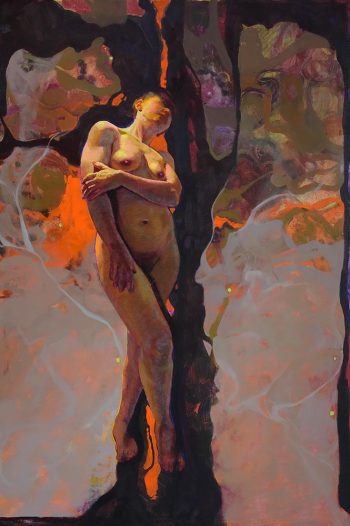
- “Forced to Feel,” oil on panel, 32×48 in.
-
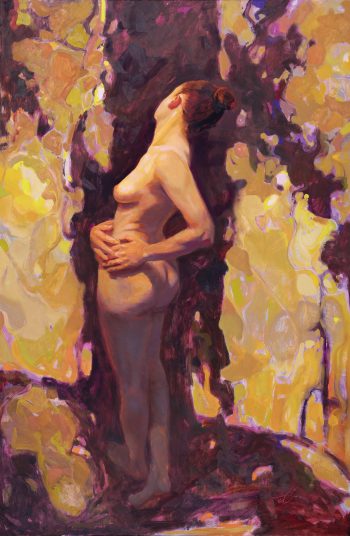
- “Komorebi,” oil on panel, 32×48 in.
Roth might also be said to employ a team of contrasting colors, such as red for warmth and blue for cool, going so far as to see red softening and even melting the borders of what is shown, while blue sharpens those perimeters. This might explain “The Power of Blue,” one of several works in which the figure creates a design for herself by draping and partially concealing her body while modifying the light that falls on her.
There’s a virtual, visual dissertation on contrast and consonance here. Consider that music and poetry are better understood together, where their common features define them while their contrasts refine them. In Roth’s “Music and Poetry,” a man and a woman distill the same lesson, their differences only meaningful in the light of their similarities, but then essentially so. Meanwhile, asked about her seeming preference for women in her art, Roth insisted she likes men and women equally, apparently as persons as well as models. The difference evident in the gallery, she stated, has to do with the models who make themselves available to her. We might add that, while some of them are self-portraits, the same practical state of mind applies. They are not meant to suggest that her human nature stands apart, or to postulate a unique identity, as so many of today’s artists claim for themselves. We dwell by choice in a discourse of separation and distinction, then bemoan that we don’t get along better.

Halee Roth, “Music and Poetry,” oil on panel, 32×36 in.
Something might usefully be said about the textiles employed by several of the figures as a part of their self-presentation. It seems clear that this is not a matter of modesty, as alternate figures leave little to the imagination. Having come to grips with the artist’s practical side, it comes to mind that they might be a way of introducing alternative hues to those of nature: the forest, sky, and some emotional equivalents offering nothing to match the yellow of “Delicate Grown Louder” or the red of “Nasturtiums.” Surely an artist must at times yearn for things that fall outside her everyday practice. But it seems more than that, and what finally takes shape in the mind is a theory of action. These yards of fabric just might symbolize the challenges and opportunities of daily life, and the mixture of casual and deliberate ways the figures handle them could represent that alternating way we have of taking charge here and negligently, even barely caring there.
Halee Roth set out to present something deep and philosophical about “beauty, light, and the power within the Human Spirit.” Another artist might barely have scratched the surface, but her seemingly symbiotic relationship with her art has enabled her to find so many connections between form and content, body and soul, and light and shade. This is that show that makes us wish we didn’t have to wait to see what she does next.

Halee Roth, “God’s Bodies”
The Human Spirit: Beauty, Light & the Power Within, “A” Gallery, Salt Lake City, through October 4.

Geoff Wichert objects to the term critic. He would rather be thought of as a advocate on behalf of those he writes about.
Categories: Exhibition Reviews | Visual Arts



Excellent discussion by Mr. Wichert regarding Halle Roth’s beautiful exhibition at A Gallery/Allen+Alan Fine Art. As thoughtful & well executed as the works he considers.