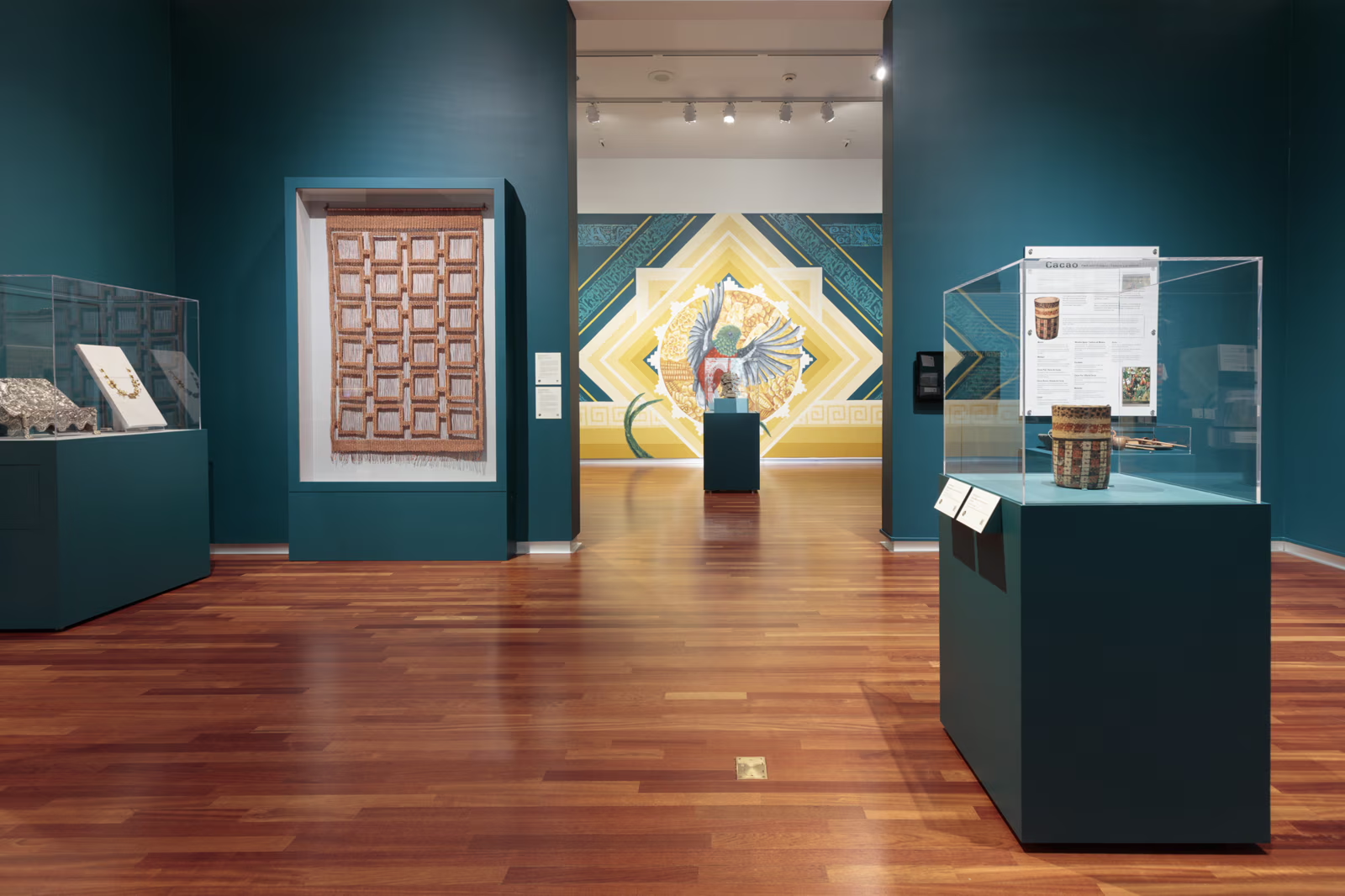
Installation view of the art on exhibition in the Mexican and Central & South American galleries, permanent collection exhibtion at the Utah Museum of Fine Arts.
The Utah Museum of Fine Arts opened its newly relocated, reimagined, and redesigned Mexican and Central & South American Galleries to crowds of visitors on Saturday, October 18 with the Nuestro pasado es presente /Our Past is Present celebration featuring live music and performance, art-making workshops and food trucks. The celebration represented the completion of a three-year collaboration between UMFA and community partner Artes de México en Utah to reimagine the collection of ancient works and their former placement in a hallway.
By moving the collection to two former European galleries, the collaborative project did more than just improve the installation and labels. It took a presentation that felt like an add-on or afterthought in a hallway with an impressively large freight elevator door and the path to staff offices, and brought it into the heart of the collections galleries. Meeting every other month from 2022 through August 2025, the curators and community partners brought UMFA alongside many museums that have stepped back to reassess the way they research, the way they present, and the way they think about the artwork in their collections.
“Reimagining these galleries was both ambitious and deeply rewarding,” says Gretchen Dietrich, executive director of the Utah Museum of Fine Arts. “The UMFA worked closely with an advisory committee of individuals with heritage and deep connections to the region. Their guidance was rooted in a powerful philosophy: that the past represented by ancient objects is not separate from the present, it is the present. The result is a gallery that better reflects the vibrant, living cultures of the objects’ origins, and the communities that continue these traditions today.”
The project was huge and undoubtedly a tremendous amount of work for all. Just the coordination and gathering of thoughts, ideas, and information from such a large group of deeply caring individuals takes dedication and determination. The learning that happened is accompanied by the trust that is built by bringing voices together, communing in conversation about history and culture. These things are clearly evident in the end product—a new vision for a part of the collection that was in great need of context and connection.
All of the works in the galleries are significant and captivating, including a rare Mayan polychrome “Vessel for cacao” from 600-900 CE from the present-day Petén, Guatemala region. This large earthenware and pigment cup reaches across hundreds of years to trace the history of something that is an active part of life today as well. Cacao has been harvested and consumed for millennia. By not only displaying the vessel itself in a Plexi-covered case but referencing it in a didactic panel nearby, the curatorial staff and community partners make the primary point of the show—that the past is present. It’s an engaging and uplifting point to make.

Gallery view of the Cacao Pot in the Central and South American gallery, with Ximena Garrido-Lecca’s “Modulations – Sequence VI”, left. Image courtesy of the Utah Museum of Fine Arts.
Many of the works speak to the natural world of Mexico and Central and South America, where the jaguar is a particularly important link between humans and nature. As written by ceramicist Hazel Rodriguez Coppola, and Esmeralda Torres, educator and artisan, “The jaguar, a pivotal figure in Mesoamerican cosmology, preserves the balance of nature by hunting animals that eat cacao, thus safeguarding life-sustaining elements. He acts as a ruler and protector, mediating between humans and nature and between humans and the heavens.” In a Mayan “Tripod plate with standing jaguar figure,” we witness the honoring of this protector and mediator.
If the jaguar figure represents a bridge between humans and the natural world, other sculpted figures extend that bridge into human experience itself.There are figures from Remojadas culture (present-day Veracruz, Mexico), Olmec tradition (present-day Puebla and Guerrero, Mexico), Colima culture, and Nayarit culture. There is a Nayarit family group that inspired one of the community partners, ceramic artist Horacio Rodriguez, to share his connection to the ceramic figures and his own work: “Ancient objects have power and tell stories. The Nayarit family group, for example, was removed from a Western Mexico shaft tomb and was probably never meant to be displayed, or disturbed for that matter. The finger impressions left by the makers on the figures allude to construction techniques. The surface decoration and the poses these figures are in all tell a story about the culture that made them and provide glimpses into what their life was like. These stories told through clay inspire me to tell the stories of our time. One day I will be the ancestor. That is in the forefront of my mind as I pass on my stories through my own artwork.”

Family group (Mother, father, and son), Nayarit culture (present-day Nayarit, Mexico), 300 BCE–100 CE , earthenware and pigment, Ulfert Wilke Collection, purchased with funds from Friends of the Art Museum, UMFA1980.165A–C Grupo familiar (Madre, padre e hijo), Cultura Nayarit (actual Nayarit, México), 300 a.e.c.–100 e.c., cerámica y pigmento, colección Ulfert Wilke, adquirida con fondos de los Amigos del Museo de Arte, UMFA1980.165A-C
Other “Community Voices” are shared on object labels in the galleries. One that accompanies two metalwork pieces bridges both geography and time. Pablo Ayala, community artist, Monique Davila, public historian, and Andrea Silva, cultural manager, compare a silver “Book Stand” by an unidentified 18th century Cuzco workshop (modern-day Peru) with a gold “Necklace with Double Bat Ornaments” from the Gran Coclé culture (present-day Coclé, Panama). “Each of these metalworks offers a glimpse of evolving power that crosses time and place, telling stories of cultural traditions, artistry, colonization, elitism, life, death and love. They reveal the enduring admiration of material and craft across multiple generations and reflect the perseverance of cultures despite attempts at ethnic erasure.”
This approach takes us so much further past just cases of beautiful objects to an interactive, fully contextualized and contemporized way to share what these objects bring to us. The book stand and necklace aren’t here just to be admired for the sparkle of silver and gold – these are storytellers.
The bridge to our time is accentuated by contemporary works in the galleries. Rodriguez’s “Prototypes for a Border Wall Mitigation Device,” was created in response to President Donald Trump’s border-wall prototypes. Rodriguez’s delicate ceramic casts of Coke bottles with rags serve as symbolic Molotov cocktails that challenge the concept of a border wall and “encourage improvised resistance.” The red color and the deep perspective of the fence image heighten the artist’s intentions and engage the viewer in contemplation of the role of border walls and their effects on people on both sides.
Ximena Garrido-Lecca’s “Modulations – Sequence VI,” is another bridge of both time and material; in this case, copper, heavily mined in her country of Peru for use in technology. The weaving merges motifs from traditional Andean abstraction with the design of a modern software company logo in an attempt to reclaim the copper medium and situate it within the long lineage of South American textile traditions. The effect of this combination is a modern design look that, from a distance, is unrecognizable as copper, but feels like a traditional textile, and then upon closer viewing, is an engaging mix of both. Like Rodriguez’s border-wall Molotovs, Garrido-Lecca uses simple materials in exquisitely crafted forms to pose questions and connect time and cultures.
Dominating the back wall of the back gallery is a mural commissioned for the revisioning of the galleries. “Roots of Time,” 2025, by Roots Art Kollective artists Miguel Galaz, Luis Novoa and Alan Ochoa, honors “the resilience of ancestral practices that still nourish both body and spirit in modern times.” The central, beautifully curving quetzal bird is surrounded by corn, a butterfly, marigold flowers, cactus, and pyramids, deftly representing the artists’ Mexican heritage. The mural is well designed with harmonious tones of teal and gold and it successfully anchors and draws the eye through the two galleries to take it all in.
With both the video accompanying the didactic panel on Cacao and a Nuestra historias/Our Stories touch screen, the voices of the community who worked on this gallery reimagining are a definitive part of the new installation. With bilingual labels and those first-person voices, it is easy to see the curatorial-community vision of “our past is present” in the new galleries.

Roots of Time” a new mural by Roots Art Kollective anchors the new Mexican art gallery at the Utah Museum of Fine Arts. Roots of Time, 2025, Roots Art Kollective (Miguel Galaz, Luis Novoa, and Alan Ochoa), Acrylic and metallic paint, commissioned by the Utah Museum of Fine Arts.

Gina Cavallo has been a curator, registrar, and executive director in museums for over 35 years. She spent many years as an art critic for publications in Phoenix. She began her career at the Phoenix Art Museum and the Heard Museum, was a founding curator at the Scottsdale Museum of Contemporary Art, spent two terms managing exhibitions at the Virginia Museum of Fine Arts, and was the Executive Director at the Mission Inn Foundation & Museum in Riverside, California. Her current role is Director of Development for Taproot Theatre Company in Seattle where she also serves as the curator of the Kendall Center Exhibition Series. She moved to Orem in 2024 with her husband, a theatre faculty member at UVU.
Categories: Exhibition Reviews | Visual Arts