

Installation view of Fidalis Buehler: Stories from the Bone Box at Modern West Fine Art. Courtesy of Modern West.
Fidalis Buehler’s paintings often appear deceptively simple: flat figures, awkward hands, distorted proportions and faces obscured by hoods or masks. He seems to be working in code, charging ordinary objects like couches, sneakers, or an inflatable swimming pool with a private mythology of stories half-remembered and half-inherited. Born in Wisconsin to a Swiss-American father and a Micronesian mother, Buehler grew up moving between the Midwest and the Pacific Islands (see our profile here). That mixture of places and traditions has left him, by his own account, always “on the periphery of cultures,” watching but never fully belonging. His art mines this in-betweenness, producing what he calls “me-myths”—visual stories that splice together folklore, religious symbolism, and family memory.
When Buehler first appeared in these pages in 2013, grouped with Brian Kershisnik and Andrew Ballstaedt, Kev Nemelka tagged the trio with the label “faux-naïve”—trained artists who paint in a deliberately childlike register, bypassing polish complication in favor of immediacy and play, their works flirting with kitsch in search for bedrock truth. It’s an artistic lineage that runs through both Paul Klee and Philip Guston (though these BYU grads avoid the dread and claustrophobia of the latter—not to mention the cigarettes, alcohol and Klansmen). Kershisnik, also showing this month in Salt Lake City, applies his “naif” method to legible scenes of family, angels, and dogs rendered with warm allegorical clarity. Buehler, in contrast, uses the same directness to keep things unsettled, suggestive but not distinct.
In Stories from the Bone Box, his new solo exhibition at Modern West, Buehler’s canvases still carry the awkward anatomy and flattened perspective that once drew comparisons to folk art and children’s drawings. They are populated with what have become his recurring figures, symbols, and masks—images that feel both intimate and inscrutable. Buehler has explained some of the personal references behind his works, turning them into a kind of literary illustration, but left to themselves—feral, roaming in the wild—his paintings become mysterious totems, speaking in a language you can hear but not quite translate.
-
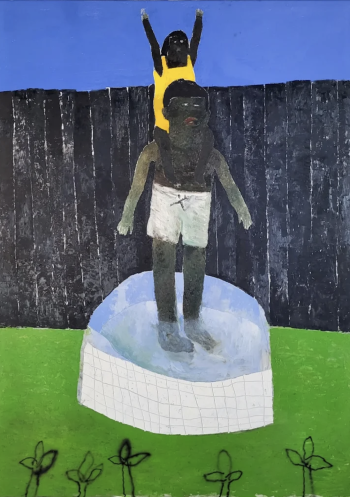
- “Pool Totem,” oil on canvas, 84×60
-

- “Bball Dad,” oil on canvas, 84×60 in.
In “Pool Totem,” two stacked figures rise from a backyard swimming pool, their bodies rigid and monumental—part Polynesian carving, part suburban snapshot, a reminder of how ordinary spaces can hold mythic charge. A similar logic animates “Bball Dad,” where a tall basketball player strides across a patchwork background, his sneakers ablaze in red. Several smaller canvases probe the uncanny in domestic space. “Couch Friend” depicts a black figure in sunglasses beside a pale, masklike head, the companions occupying a pink-walled interior. “Half and Half” pairs a dark and light head on a neutral ground, a blunt but poignant symbol of dual heritage and identity’s unresolved halves. Similarly, in “Two-Headed Horse,” the creature stands still yet divided, its twin heads pulling in opposite directions. The exhibition’s namesake, “Bone Box,” shows a blue skull emerging from a yellow container. Playful, even cartoonish, its starkness nevertheless recalls a reliquary or ritual object. Like so many of Buehler’s works, it is both artifact and invention, archaeology and anthropology.

Fidalis Buehler, “Cipher 1,” screen print, 27×20.5 in.
Alongside these larger paintings, for which he is best known, Buehler introduces several ancillary works exploring new mediums. A wall of small works on paper isolates recurring motifs—hands, heads, animals, crowns, arrows. A screenprint in the back corner arranges such shapes into a neat grid, resembling a glossary or syllabic alphabet that might spell out the message we seek if we can crack its code. Small wood sculptures sprinkled throughout the gallery—”Dog and Hand (Story of Nomati),” “Whisper (Story of the Navigator)”—raise these motifs like primitive signposts. Most ambitious of all, with wire, plaster, and paint, he has transformed an earlier avian motif into a human-length wall sculpture, like a children’s drawing that has stepped off the page and taken corporeal form.
Together these works tempt viewers to decode Buehler’s system, even if the key remains withheld. His practice hovers at the threshold of the personal and the collective, which is what propels it—what makes it both enticing and frustrating. Writing in 2019, Hannah McBeth linked his wolves and hooded figures to Jung’s collective unconscious: personal symbols that also echo primordial archetypes. Geoff Wichert, in 2024, described his collaborations with Mitch Mantle as explorations of the “phantom limb,” where one image resurrects another half-forgotten. The point is not to resolve the meaning but to live in its suspension.
Stories from the Bone Box feels like both a homecoming and a reckoning. It gathers the artist’s long-running obsessions and stages them as a lucid dream you can walk into. Figures press forward in flattened space among ritual props that repeat like half-remembered refrains as colors thrum with the jittery confidence of a child’s drawing while the artist strives to do less in order to do more.

Fidalis Buehler, “Sky Bird (After Children’s Mo’olelo),” wood, wire, plaster and oil, 67×77 in.
Fidalis Buehler: Stories from the Bone Box, Modern West Fine Art, Salt Lake City, through October 31.

The founder of Artists of Utah and editor of its online magazine, 15 Bytes, Shawn Rossiter has undergraduate degrees in English, French and Italian Literature and studied Comparative Literature in graduate school before pursuing a career in art.
Categories: Exhibition Reviews | Visual Arts



At the risk of seeming prejudiced in favor of my editor (which, frankly, I am very much) this is the best and most informative exploration of Fidelis Buehler I’ve had the pleasure to read. All that time at the universities must have provided Shawn with a master’s degree in research, and the result is our pleasure in learning and knowing.