
Balancing her dual roles as artist and gallerist, Meri DeCaria stands beside one of her vibrant floral compositions at Phillips Gallery—her tool belt hinting at the hands-on work of directing Utah’s longest-running art gallery while continuing to create art of her own. Image by Steve Coray.
In her newest body of work, Meri Decaria turns inward, translating grief and renewal into color, rhythm, and form. Created in the wake of her husband Mark’s passing in 2021, the series represents an introspective exploration of what she calls “a reflection of my new reality.”
“These pieces were born of love and loss,” she says. Her husband, Mark Robert DeCaria, was a longtime Weber County Attorney and later a judge in Utah’s Second Judicial District Court. The two were married for twenty years, sharing a life centered on art, travel, and family. “While navigating the disorienting rush of grief and change, my art was a refuge from uncontainable emotions—from the pain of having my future radically altered to the quiet resilience of rediscovering a new normal. I’ve found salvation in the studio, and in the work itself.”
That sense of introspection manifests not in somber tones but in confident, rhythmic compositions. True to her long-standing visual vocabulary—bold forms, vibrant palettes, and a palpable sense of movement—these new works pulse with the quiet energy of recovery. Viewers can trace echoes of her late-1960s design aesthetic, the “bold, groovy” sensibilities that continue to anchor her approach. Yet within the crisp structure of her compositions, a new kind of lyricism emerges.
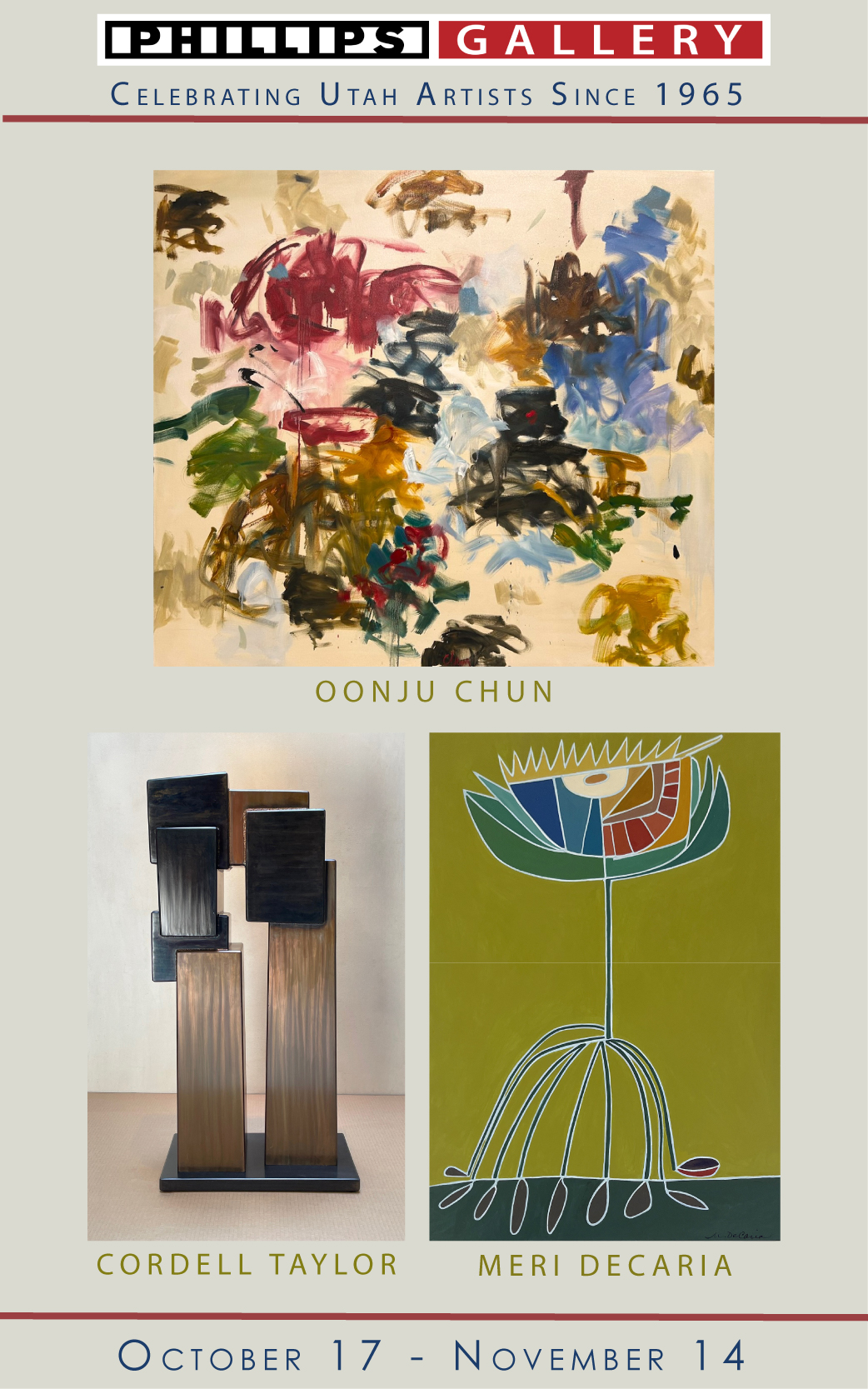
Music—especially jazz—threads through this exhibition like a guiding undercurrent. The artist’s process, she says, is intuitive, a “direct output of the weight and inspiration I carry as I move through life.” In anticipation of her upcoming show at Phillips Gallery, where her work is paired with the paintings of Oonju Chun and the sculptures of Cordell Taylor, Decaria has been posting several of her new works to Instagram, where she notes that the social media site’s audio feature “has both simplified and complicated my intent. Sometimes the music clicks,” she says, “as in Pink Martini’s ‘Donde Estas, Yolanda,’ which delightfully captures the frivolous color play of ‘Fragments,’ while George Benson’s ‘Breezin’ celebrates the bold form and color of ‘Astratto VIII.’ Other times, it’s an imperfect but close enough match, like using Noga Erez’s ‘End of the Road’ for ‘Sucker Punch’—a vibe that hints at the painting’s tumult when no suitable song about the specific grief of losing a partner could be found.” The result is a kind of visual improvisation, where color and form riff on one another like instruments in conversation. Even in works born from mourning, there’s an unmistakable vitality—a sense that creation itself is an act of endurance.

Meri Decaria, “Sucker Punch,” acrylic on board, 9×17 3/4 in.

Meri Decaria, “Beyond The Blue Note,” acrylic on board, 13 x 13 in.
Decaria is busy hanging her show this week, shifting from her private role as artist in the studio to her more visible role as director of Phillips Gallery. She has spent more than three decades championing local artists and shaping the state’s visual landscape at Salt Lake City’s longest-running art gallery. “Phillips has provided me with an insanely rich visual and social environment,” she says. As both artist and gallerist, she’s acutely aware of shifts within Utah’s evolving art scene. The state’s population boom has brought new collectors and fresh energy to the community. “What excites me most is the increased interest in acquiring Utah art,” she says. “This flood of new residents has brought an open-minded, broad range of collectors. At Phillips, we’ve seen a noticeable increase in engagement and a desire for deeper connection—not just with the artwork but with the gallery community.”

“‘Harbor,'” Decaria says, “was a conscious step toward a new direction, which I now see as a visual representation of the hours of solace spent in my home.”
That vitality bodes well for the gallery’s future, though she admits sustainability is always on her mind. “The art business is unpredictable,” she says, “… but right now, thank goodness, with the influx of people moving into this area, business is good. Our loyal patrons have long understood the power of art to provide a respite from whatever they may be navigating in their lives. While some younger generations tend to seek adventure over possessions, hopefully, by providing an enriching art experience, we’re encouraging their future allegiance.”
Even as digital life reshapes how people encounter art, she sees the gallery as a sanctuary. “In an age of endless digital discourse, our gallery stands as a counterpoint—a treasure trove of consolation.”
Oonju Chun, Meri Decaria, Cordell Taylor, Phillips Gallery, Salt Lake City, October 17-November 15. Opening reception: Friday, October 17, 6-9 pm.

The founder of Artists of Utah and editor of its online magazine, 15 Bytes, Shawn Rossiter has undergraduate degrees in English, French and Italian Literature and studied Comparative Literature in graduate school before pursuing a career in art.
Categories: Exhibition Reviews | Featured | Visual Arts