
Mark Knudsen, “Along I-70,” acrylic on panel, 11 x 37 1/2 in.
Regular visitors to Phillips Gallery will be familiar with the work of Mark Knudsen, whose paintings of what he has called “the new West” have been a regular presence in its exhibitions for several years. Knudsen’s style—rooted in his years as a designer and illustrator for The Salt Lake Tribune—is marked by broad, dry expanses of earth tones and deep, unfettered shadows, conveying with minimal elements the light and shadow of the Colorado Plateau.
Knudsen is drawn to the familiar yet striking formations of Utah’s badlands, whether the reds and salmons of rounded Navajo sandstone or gray Mancos Shale hills topped with golden caps, their forms etched by millennia of erosion. But beyond their natural grandeur, Knudsen’s compositions capture the evolving reality of the West, where nature and infrastructure intersect. Railroad tracks, power lines, highways, and vehicles subtly yet insistently weave into the landscapes. In some works, these elements are peripheral; in others, they are unavoidable disruptions. A camper punctuates the foreground of one piece, while the thin white streaks of airplane contrails cut across a pale blue sky above the San Rafael Swell. In Mill Canyon, the imposing lattice of power lines looms over the red rock formations, an intrusive geometry against the ancient landforms. Fences, poles, and roads reframe our perception of the landscape, reflecting how most of us encounter these vast spaces—not as untouched wilderness but as scenery viewed from the window of a moving car.

Mark Knudsen, “Into The Reeds,” acrylic on panel, 11 x 30 in.

Mark Knudsen, “Mill Canyon,” acrylic on panel, 11 x 37 in.
The exhibition’s layout enhances this experience. Knudsen’s long-format works, all of similar size, are displayed at eye level in a horizontal arrangement across three walls, evoking the sensation of looking through a series of windows. The effect is immersive—one is surrounded by a panorama of the West, the paintings offering glimpses of a terrain both expansive and interrupted.
Downstairs, in contrast, Claudia Sisemore’s stained and painted canvas works offer, whether intentionally or not, an abstraction of the Western landscape. Where Knudsen presents the land in recognizable forms, Sisemore distills its essence—its colors, its rhythms, its tectonic forces—into layered compositions of shape and hue. The weight and balance of rock formations, the shifting interplay of earth and sky, the compression of geologic time—all seem embedded in these canvases.

Claudia Sisemore, “Untitled,” acrylic on canvas, 64 x 54 in.
Sisemore, who died last August, may be—and may remain—best known as a filmmaker, who in particular documented the lives and works of Utah artists like LeConte Stewart, Doug Snow, Alvin Gittins and Anton Rasmussen (since her passing, the Salt Lake City Library has been compiling a DVD collection of her films); but she began her career as a painter in the early 1970s. Several of these are from that period, and while the works are untitled, it’s hard not to see in them a response to the western landscape.
One can sense the echoes of canyon walls, the fissures of desert rock, the contrast of sky against the earth’s mass. In some pieces, deep blues and greens suggest the shadows of a slot canyon or the fleeting pools of water after a storm. In others, siennas and ochres vibrate against fields of black and indigo, like the last light on the cliffs at dusk. There is a palpable solidity to her compositions, yet they resist confinement; turn them on their sides, and they still hold their balance, as if gravity itself is an adjustable force within their world.
-

- Untitled, 1975 Acrylic on canvas 26 x 26 in.
-
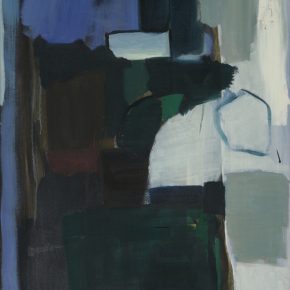
- “Considering Green,” 1975 Acrylic on canvas 30 x 22 in.
-
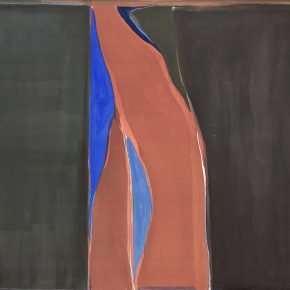
- Untitled, 1975 Acrylic on canvas 41 1/2 x 50 in.
Together, Knudsen and Sisemore offer two ways of seeing the land. One, a documentarian’s view, depicting the land as it is shaped by time and human presence. The other, an internalized response, a meditation on its elemental power.
Mark Knudsen and Claudia Sisemore, Phillips Gallery, Salt Lake City, through February 14

The founder of Artists of Utah and editor of its online magazine, 15 Bytes, Shawn Rossiter has undergraduate degrees in English, French and Italian Literature and studied Comparative Literature in graduate school before pursuing a career in art.
Categories: Exhibition Reviews | Visual Arts