
, from left to right: Eugenie Murdock “Pillows,” Mimi Rhodes “Krokbragd Rug” and “Sunset on the Nile,” and Phyllis Mandel “Rainbow Weave Jacket.”
Spend a little time with the gifted, itinerant street painters on YouTube and it soon becomes apparent that almost anything can become the support for a painting, from a guitar to a guitar case, or a laptop’s cover, or even an inexpensive, mass market oil painting on canvas. So why, you might ask, would Debbi Sigg go to the considerable trouble of painting on diaphanous and fragile pieces of silk? The answer, either in “Disappearing” or “Enchanted Nocturne,” has to do with the power of silk to absorb not just paint, but light itself, and to bring colors to life so they glow as they do nowhere else.
“Disappearing” accomplishes a feat of transformation, hung as it is above a long, narrow table on which Susan Hainsworth’s overshot runner lies, creating the effect of an altar, or perhaps a formal entryway. A visit to Slow Cloth: A Celebration of One Thread at a Time rekindles the appreciation of how much indispensable, yet accessible and even affordable luxury textiles add to our lives.
To say this, however, is rather to invert the values celebrated in the awards given out by the sophisticated juries of the Mary Meigs Atwater Weavers Guild of Utah, in their biennial exhibition, currently in the Pilar Pobil Celebration Gallery at the Utah Cultural Celebration Center. Weaving, a term the guild uses as a way of collecting virtually every form of textile art, is surely among the oldest human crafts, with examples found regularly by archaeological expeditions excavating their way back into prehistory.

Mittens by Lisa Sewell
In fact, judging by the numbers, the most popular forms this year are Latvian Selbu-Style mittens and hand-painted warps. The former are the contribution of Sarah Marsden, who submitted no less than 20 original color patterns. Beginning a weave by dyeing or painting the warp threads produces optically tactile fields of color that beguile the eye while qualifying as abstract paintings in depth. As Ivy Dehart’s “Cloudy Day” so aptly demonstrates with its Fancy Twill, the addition of a regular texture to such a free color application makes for a rich combination of contrasting patterns.
Of course, being in an art gallery where they are skillfully mounted by Mike Christensen and his staff brings out the ornamental qualities of even the most functional objects. But there’s an irony here; many of the makers are disappointed to learn that their accessories are regarded by their new owners as too precious to wear or use. That pair of hers-and-his wedding towels lovingly and skillfully woven by Nickie Allen may languish on the shelf. When she realized that her double weave scarf wouldn’t have enough suitable opportunities to be worn, Phyllis Mandel reworked it into a jacket suitable to wear on more occasions. Meanwhile, Barbara Ishimatsu chose thematically correct, local pine needles to bundle into her “On Pins and Needles” pin cushion, thereby making an object that, like many here, can be appreciated when it is not in use as well as when it is.

Lisa Chin, “Into the Light”
-
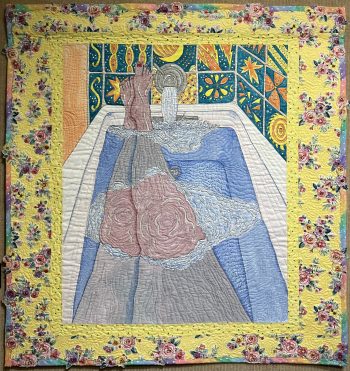
- Rosanna Lynne Welter, “Islands in the Stream”
-
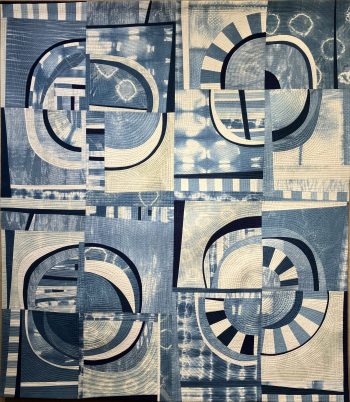
- Sheryl Gillilan, “Wabi Sabi Blues”
We know from his autobiographical images that in Jan Vermeer’s house, Persian rugs served as tablecloths. Prolific quilt-maker Sheryl Gillilan’s “Wabi Sabi Blues” could possibly double as a baby blanket, all but assuring the child would grow up cerebrally advanced as befits the years spent in its environmental embrace. In fact, both wisdom and wit are to be found among these artisans. The title of Rosanna Lynne Welter’s “Islands in the Stream”—a non-denominational phrase that gathers Hemingway, the Bee Gees, Dolly Parton and Kenny Rogers, Marvin Gaye, and others into its domain—invokes its subject’s knees in a way that should take viewers back to their childhood bathtubs. Not one but two playfully ornamental deer heads by Eugenie Murdock are named for “Jane” and “John Deer.” Michele Pugmire preserves her photo transfer-threatened modesty behind the flames of “On Fire—A Self Portrait.” And Lisa Chin’s “Murder in the Garden” may well baffle viewers who don’t remember that the collective noun for crows is “a murder of crows.”
We may hope that no visitors come thinking that textile fabrication and ornamentation are settled arts. If they do, what will they see when they stand before Sandra Sandberg’s “Variegated Yarn Experiment 2” or Jane Roberts DeGroff’s “Stitch Over Stitch.” In the former, elements of mere yarn take on a visual solidity that normally belongs to metal, while in the latter, two elements of quilting—construction and overstitching—part company to cavort in ways that take the viewer on an optical adventure.

Debbi Sigg’s “Disappearing” hangs above Susan Hainsworth’s runner.
Nor is it true that textiles are a niche interest. Two years ago, in numbers that would rival those of the Spring Salon, there were 130 entries in the show. For this year, a no-doubt painful administrative adjustment was made that brought the number more closely into line with the UCCC’s capacity, but which did nothing to assuage the writer’s pain at having to bypass so many beautiful and intriguing projects and ignore the thousands of hours of skilled labor that went into their making. In this world, artists must routinely part company with their skillfully-crafted children, but the Mary Meigs Atwater Weavers Guild offers the means for creative and DIY individuals to express themselves in making things they can keep and take pride in and use and enjoy. We don’t usually indulge in unsolicited recommendations, but anyone who imagines time spent spinning, dying, weaving, painting, and stitching fabrics, and doing it well, owes it to themselves to investigate this avenue to more satisfaction in life.
Slow Cloth: A Celebration of One Thread at a Time, Utah Cultural Celebration Center, West Valley City, through October 15.
All images courtesy of the author.

Geoff Wichert objects to the term critic. He would rather be thought of as a advocate on behalf of those he writes about.
Categories: Exhibition Reviews | Visual Arts