

Catherall displays her Kitchener stitch tattoo—both homage and practical reference—honoring the historic knitters who crafted for wartime relief. Image courtesy of the artist.
In the tattooed hands of Virginia Catherall—inch markings on her left hand for ease of measuring lengths in purl and knit—two simple sticks and a single strand of yarn transform into wearable landscapes that capture the sublime beauty of Utah’s salt flats and vistas of glacier-carved mountains. Her journey from casual knitter to acclaimed textile artist reveals not just a personal evolution, but connects to knitting’s long history as both a practical craft and a powerful medium of artistic expression.
I have been acquainted with Catherall for years, but it wasn’t until she began her one-sweater-a-month series in 2022 that I became enthralled with her work as a knitter and a fiber artist. For each of 12 months in a row, she would model her sweater of the month on Facebook and Instagram, everything from her “Sprout” garment in “eye-watering chartreuse” (her term) to elaborate cabled specimens employing yarn from a dye lot whimsically christened “goose turd green.” In her final (December) piece, a Myrna pattern knit in Rios by Malabrigo in Santa Rita colorway, there she is wearing a Happy New Year tiara and looking gorgeous in her signature “Velma vibe” (as in Scooby Doo’s bespectacled and bobbed sleuth in a quotidian turtleneck sweater.) She gives new meaning to the 1940s/50s “sweater girl” phenomenon personified by Hollywood actresses like Lana Turner, Jayne Mansfield and Jane Russell.
I don’t know a thing about knitting nomenclature, but it’s been fascinating to watch Catherall spool-out— no pun intended—not just her monthly sweaters but all kinds of what she calls “wearable art” inspired by everything from an 18th-century “cyanometer” to sunsets and from oracular seed pods to waterfalls luminescing through rock flour-filled meltwater in Glacier National Park where she was recently artist-in-residence.

In November, 2018, The Utah Division of Arts & Museums paired the photographs of Kelly Baisley (right) with Catherall’s landscape-inspired textile works. Image courtesy of Utah Arts & Museums.
And then, as her starting point, there are the bears and other critters like the Calliope hummingbird with its vibrant gorget on the male’s throat. All of it is transformed into glimmering, textured fibers deftly knitted into complex and staggeringly beautiful patterns. All of them designed to be donned with aplomb.
“My marathon sweater knitting is helping my creative block,” she wrote in one of her sweater posts, “as I am starting to sketch original ideas again for my own art.” With knitting, Catherall makes a distinction between craft and art, the latter defined as having “theory behind it.”
“This idea of immersing yourself in the landscape, you know, that’s part of why I make [my art] wearable; … Every time I go out and see a landscape, I just want to immerse myself in it. I want to surround myself with it, be enveloped by it…that might be why I think of it as fine art, whereas a lot of times folk art and craft is, you know, just functional. I still do knit ‘crafts.’ I knit my sweaters and, you know, socks, but I see that as separate from the landscape art.”
That landscape art has found its way into museum collections and gallery shows along the Wasatch Front. But the baseline of it is always two needles and a string, and this duo-Master’s degree-ed artist is animated and her work informed by the history and cultural signifying of knitting.
Revolutionary Roots
“Knitting throughout history has been kind of a subversive thing,” Catherall explains, “because women can do it; that’s how they can express themselves, and that’s how they can change the world.” The political dimension of knitting dates back centuries. During the French Revolution, women known as “tricoteuses” (French for “knitting women”) deliberately sat in the front rows at public executions, knitting while watching the guillotine fall. “Women of the revolution were told they couldn’t be at the beheadings because it was too gory for their female sensibilities,” Catherall recounts. “They blatantly sat on the front row with their knitting, purposefully getting sprayed with blood to show that women were just as much part of the revolution as men.”
This tradition of textile creation as resistance continued through history. During World Wars I and II, knitting became both practical necessity and patriotic duty as home-front women created garments for troops. It was during this period that the famous “Kitchener stitch”—a seamless grafting technique for sock toes—gained prominence. Named after the head of British national security during World War I, this technique helped prevent trench foot among soldiers by eliminating uncomfortable seams.
“It saved the world,” Catherall says. For utility’s sake, as well as to honor the tradition, Catherall has the entire complex Kitchener knit sequence—notoriously difficult to remember—tattooed on the inside of her left arm.
The tradition of political knitting continues to the present day, with the pink “pussyhats” that emerged during the 2017 Women’s March serving as a recent example of how this craft can become a vehicle for protest and solidarity.

The complex Kitchener stitch, memorialized on Catherall’s arm, is a nod to knitting’s revolutionary roots and her commitment to honoring its technical heritage.
A Personal Thread
Catherall’s own relationship with knitting began in the 1970s when her grandmother, an avid knitter who once crafted entire suits in the 1940s, taught her the basics. But it wasn’t until graduate school in the ’90s that Catherall seriously returned to the craft.
“I was grinding my teeth from stress,” she recalls, “and the doctor said, ‘Why don’t you take up something like knitting?'” This recommendation proved transformative, reconnecting Catherall with a practice that would eventually become her passion. For years, Catherall knitted purely for craft—creating sweaters, baby items, afghans and scarves from patterns designed by others. But a fortuitous moment on the Salt Flats in 2010 changed everything.
Catherall was traveling for work with Utah Humanities (she is currently the outreach director for the Utah Museum of Fine Art) to critique a museum exhibit in Wendover, Utah, when she and her colleague ran out of gas on the salt flats. Stranded and waiting for rescue, Catherall found herself mesmerized by the sublime landscape stretching before her. “I remember thinking, ‘Oh, I wish I could draw, or I wish I could paint so I could capture this moment in this landscape,'” she recalls. “And as I was sitting there, I thought, ‘But I can knit! Maybe I should knit this landscape. What would that look like?'”
This epiphany led to the creation of the “salt flat scarf,” her first piece of wearable landscape art. Though initially rejected from a design competition, the piece found its home in an art exhibition where it won the Jury Award—validating Catherall’s intuition that her knitting transcended mere craft. “I always thought of them as wearable landscapes,” she explains. “I became an artist because the design world [to which she had submitted work early on in a state competition] rejected me.”

An image of Catherall’s “salt flat scarf” being blocked in 2011. Image courtesy of the artist.
The Artist Emerges
From that transformative moment on the salt flats, Catherall began developing a distinctive body of work inspired primarily by Great Salt Lake landscapes. Her wearable art pieces earned consistent recognition, appearing in statewide annual shows and specialized exhibitions.
This success led to a series of prestigious artist residencies, beginning with the Black Rock Desert in Nevada—the remote location where Burning Man takes place. It was in this stark environment that Catherall created the “Great Basin Cyanometer,” inspired by a historical scientific instrument used to measure the color and intensity of the sky. The piece so impressed the state of Utah that they purchased it for their permanent collection.
“Once they bought my artwork, I felt like a real artist,” Catherall says. She continued applying for residencies and exhibitions, with her work appearing in museums throughout Utah. To date, she has completed residencies at Great Basin, Glacier, Black Rock, and Capitol Reef, with each landscape inspiring new wearable art pieces.

Catherall’s “Great Basin Cyanometer,” 2015, wool textile, 22 in. x 22 in. x .25 in., is part of Utah Arts & Museum’s permanent collection.
A visual, tactile diary
In full disclosure, I first contacted Catherall for this article for selfish reasons; I was doing research for a historical novel involving my great-grandmother who, in my manuscript, knits her way through the adventure and trauma of settling much of the interior American West. Catherall confirmed what I suspected—that women and some men use knitting as a kind of therapeutic centering as well as a marker of identity, whether it is political or personal. “When you knit, you get the same benefits as if you meditate,” she says. “But there’s also been a lot of studies about memory and Alzheimer’s and how knitting can help with that.” Furthermore, activities that are two-handed, she explains, citing recent studies—that is, using both hands at the same time—is a way that your brain can heal and also grow. “All of those things are this scientific way of saying something that a lot of women already know, which is that knitting can be therapeutic; knitting can help you get through hard times.”
Catherall has clearly transcended the knitting-to-cope-with-life’s travails to a place of art—both high and “wearable.” One of her most striking pieces is her Glacier Time scarf, a visual representation of her time spent at the national park during her month-long residency. Intertwined throughout are gemstones that, by their mineral character, indicate what type of wildlife she saw and when, or in what time sequence: large and small mammals, reptiles, amphibians, insects and fish. The color of the yarn indicates what activity she was doing at the time. “If you see the artwork in person,” she says, “look closely to find when I saw my first bear, how much time I spent knitting vs. hiking, and the mousetrap incident at three a.m.!”
-
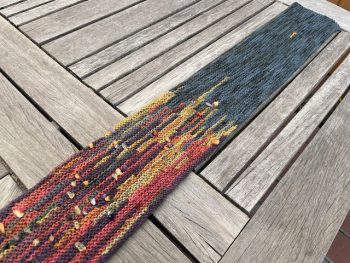
- The Glacier Time scarf chronicles Catherall’s days during a national park residency, with colors indicating activity and gemstones marking wildlife sightings—an artistic timeline in fiber form.
-
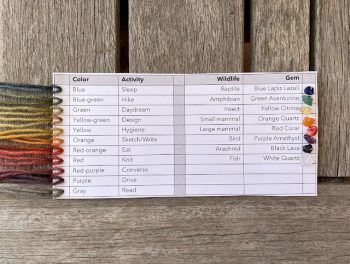
- A legend from Catherall’s Glacier Time project links yarn colors to daily activities, wildlife encounters, and gemstones, turning a month-long artist residency into a visual, wearable diary.
This data set of memory is like a diary, but visual and in knit. “I knit in real time,” she explains. “So every night I would knit what I did that day, like you would write in your diary, just like that. So it was real time, and then you get to wear it!”
Catherall continues to create both traditional knitted items and artistic pieces, seeing them as separate practices. While she still knits sweaters and socks for practical purposes, her landscape-inspired pieces represent something different: theory-based art that uses textile techniques to explore human relationships with natural environments. In Virginia Catherall’s hands, knitting—an ancient craft with revolutionary roots—has been transformed into a contemporary artistic medium capable of expressing sublime natural beauty, rendering landscapes wearable, and quite literally, enveloping the wearer in art.
She is indeed a sweater girl for our age.

Virginia Catherall’s “Fireweed,” 2023, hand-knit Merino wool, comes from her residency at Glacier National Park and is part of the Springville Museum of Art’s 2025 Spring Salon.

Categories: Artist Profiles | Visual Arts



Virginia, I have always loved your work, brilliant!
Coincidently I was thinking of Virginia’s work this past weekend!
And now I am thinking of Madam Defarge in “A Tale of Two Cities “