

Fern & Reed’s Daily Life installation at Commerce & Craft showcases their signature blend of vintage textiles, functional design, and contemporary whimsy. Image by Shawn Rossiter.
As someone who collects vintage tablecloths for their linocut style patterns and whose taste for cottagecore is in her Wisconsin genes, as someone who comes from a lineage of Midwestern farmers and was named after a grandmother who, in the 1930s, practiced a craft that went out of vogue and has since reemerged, seeing Fern & Reed’s vintage linen appliqué works at Commerce & Craft felt like sitting at the Formica chrome table with my grandma the way I was never able to. It’s vintage turned contemporary, the spunk of today interpolating the past, a new life brought into vintage fabrics and linens that remain true to their origins, with the flair of this new day.
Fern & Reed is the collaborative project of artists Lisa DeFrance and Suzanne Bybee. Originally from Billings, Montana, DeFrance is a textile and performance artist who for 12 years was the principal in the performance art group Tripod. She earned a BS in Apparel Design from OSU in Corvallis, Oregon, and moved to Salt Lake City with her artist/poet husband Steve Creson in 2003. Bybee, originally from Anaheim, California, earned her Master of Fine Arts in painting from Claremont Graduate University in Claremont, California in 2000. Now based out of Salt Lake City after a 12-year stint in Washington, D.C., she has been working on collaborative and curatorial projects with other artists as well as reviewing work and creating art, both digital and analog—a conversation between technology and the physical aspects of art-making.
The duo, who share a space in the Bogue Foundry artist studios on 400 South and 700 West in Salt Lake City, uses the type of old linens that would have lain across the buffet in your grandmother’s dining room and then attach vintage-patterned fabrics in the recognizable yet unidentifiable shapes that are signature to their multimedia practice—thus creating functional homewares with a contemporary, cottagecore elegance that meets spontaneity and play. They do not shy away from contrasting (clashing) patterns and colors—floral patterns and cherries on top of stripes, upholstery and polka dots on white linen. Soft and light, these works could easily be imagined billowing in the summer’s wind on the clothesline out back.

Vintage towels reimagined: Fern & Reed stitch layers of meaning into domestic linens, combining the decorative with the conceptual. Image by Shawn Rossiter.
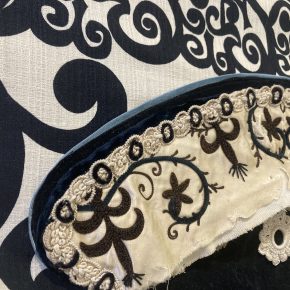
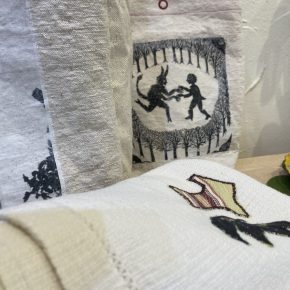

At Commerce & Craft, where they have been the featured artist since the April Gallery Stroll, a quilt hangs valiantly above a mantel-like shelf. What looks like vintage upholstery is appliquéd strategically among cross-stitching of flowers and quilt patterns reminiscent of the craft-based practices of women relegated, out of gendered norms, to homemaking. Yet Fern & Reed reclaim those practices as a way for women to make their mark on the world, to take up space and be recognized for these thankless practices that make a house a home, keeping our ancestors—the women before us and their efforts—alive in our influences today.

Fern & Reed’s Vintage Acorn Filing and Storage Cabinet.
The pieces at Commerce & Craft only scrape the surface of Fern & Reed’s stock. In their online portfolio, the Home and Office Wares section, with its lampshades and tape dispensers and desk lights, is clearly the genesis of duo’s amorphous spontaneity and shape layering. These pieces have the feel of graffiti art, the sinuous lines of wall spray paintings or a tag—the repetitive, sure strokes of practice. The “Vintage Acorn Filing and Storage Cabinet” looks like it was out on the corner sidewalk having lived several lives before its present incarnation. It is a dance of colors and shapes, transparency and layering.
Their cotton muslin tunics, meanwhile, are brinking on possibility, balancing simplicity while mostly leaning into chaos. The point of them, no doubt. But the limitations of sewing, the boundaries of the medium with the vintage linen appliqués, serves the process well. It transforms the sporadic into the compositional. It takes the doodle to design, to the refined, to the intentional and practiced, keeping alive the brightness and spontaneity and play the homewares and tunics originated with, while tapping into the elegance of the fashion design and painting backgrounds of the two artists. They develop ideas through the making process, observation, experimentation and mutual exchange, their artist statement says, seeing each practice influence, play, and work in conversation with each other.
When the linens are in a collection together, you can see the process and how it works across the pieces. And within each set—there are mutual patterns on all the pieces though each remains unique in its randomness. They are fun and talkative, creating a conversation, between the artist’s collaborative practices, through the shapes’ relation to one another, each unique piece chatting with its set mates. They each have personality while being a part of a greater picture. Each is an original piece of fine art, but made for regular use. Beauty and function intertwined.
Today, linens are usually left to chain art stores and large industry means of production. With Fern & Reed, however, by reclaiming old linens, old fabric that has been lost to time and attic bins and moths, life is breathed back into what some would consider outdated, ridiculous, out of vogue. These fabrics go on to live another day in another form.
As a nostalgic person who has a hard time cutting up vintage National Geographics for her own paper-based art practices (collage, book making, journalism)—out of nostalgic preservation and an appreciation for antiques—cutting up such old linens almost feels sacrilegious. But through their feminist reclaiming of an old practice, Fern & Reed reimagine these linens, bringing them out of their old state of un-use and repurposing them for functional beauty with reclaimed craft and tradition and purpose. Even more, conversation—between the past and the present.

From Fern & Reed’s online portfolio: these cotton muslin tunics brim with color, chaos, and charm—transforming doodles into design and garments into wearable conversations.
Commerce & Craft can be found next to Tea Zaanti on 1100 East, right before the nightmare that is 2100 South. Original pennants, quilts, tea towels and runners are for sale in the handmade marketplace among other small production artists, makers and designers. Fern & Reed’s works will be up through May 13 at the marketplace, otherwise their pieces can be found on their website.

Genevieve Vahl is a writer, farmer and artist from Milwaukee, Wisconsin. Her writing focuses on how art and community intersect, how to bring access to food and covering climate solutions around the Salt Lake Valley. She also writes poetry, binds artist books, makes paper and runs cyanotype prints from film.
Categories: Exhibition Reviews | Visual Arts





Thank you for this amazing review! It was such a great surprise and treat.
Sincerely, Fern & Reed (Lisa and Suzanne)