

There’s a tree-lined, shady lane in a Salt Lake City suburb that isn’t quite a dead-end street, blending as it does almost imperceptibly into the grounds of the local grade school. In the middle of that final block, behind a hand-forged iron gate, sits a modest-looking home—a house from which have come probably more individual works of art, in more divergent media, than have emerged from any comparable dwelling. This is the home of Ric and Marcee Blackerby, and contains both of their studios, from which, over more than 60 years, emerged some of the most original and engaging works of art in two- and three-dimensions to record and grace the look and style of the Utah scene.
The decision this year by Dan Cummings and Michael Christensen to include The Horse They Rode In On, a tribute to Ric and Marcee, alongside this year’s 21st iteration of The Face of Utah Sculpture, provides what could be a last chance to see them together, in what comes as close as may still be possible to a complete survey of their all-inclusive, innumerably miscellaneous, visual brilliance.
Neither of the Blackerbys seems to have felt any restrictions by reason of conventional artistic boundaries. Both artists made their early marks as painters, a medium in which over the years they would document subjects that ranged from their childhood experiences to the romance of their lives together—and beyond. Neither, though, would confine themselves to two dimensions, but each produced a distinctive and personal sculptural style.

Ric Blackerby, “The Horse We Rode In On”
Ric is known in particular for public sculpture and large, often fanciful studies of animals, in particular colorful insects. He also produces abstract objects compiled from found domestic fixtures like lamps and mixed-media, painted objects that he often playfully modeled on imagery seen in definitive 20th-century artworks that he brought off the canvas and into real space.
In the age of the shadow box—in particular the arcade game-inspired boxes of Joseph Cornell—Marcee developed a unique combination of two-dimensional images emerging into three-dimensional assemblages that was all her own. In addition, both worked with textiles, including elaborate works executed in part or entirely from vintage neckties.

Marcee Blackerby, “Divine Debri”
In addition to his art, Ric developed a career in music, accompanying himself on the guitar while he sang covers of songs by the likes of Canadian poet Leonard Cohen. One of the most unusual duets of our time was a frequent performance by Ric, accompanied by Marcee in the front row who kept up a running conversation with her entourage so that together they entertained the entire room twice.
Marcee actually began her career as a writer, and wrote eloquently about her experiences growing up in Castle Dale, where she was born in 1944. In an unpublished memoir she had resumed working on before her sudden death in 2019, she describes being a member of the last American generation to face epidemic Poliomyelitis, which withered her legs so that she could not walk without braces. Ironically, children born as little as two or three years later would be the beneficiaries of not just one, but two powerful vaccine protocols that as much as wiped out the disease. One can only wonder what she would have to say about the present political climate in America, where the threat of Polio once again looms in the lives of a new generation.
-

- Ric Blackerby
-
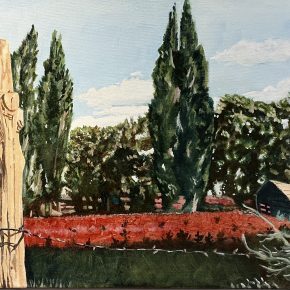
- Ric Blackerby
-
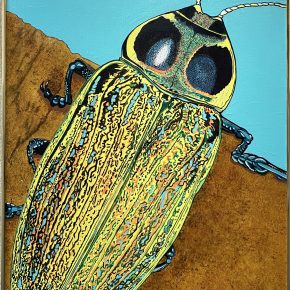
- Ric Blackerby
-

- Marcee Blackerby
-

- Marcee Blackerby
-
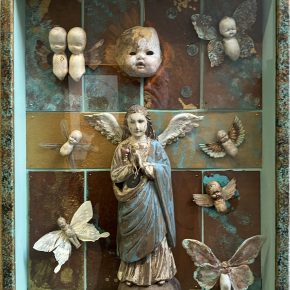
- Marcee Blackerby
Marcee eventually tired of the hassle of walking with required, heavy iron braces, and chose instead to use a hybrid of wheelchair and rolling platform that, while it confined her to a single floor of her home, gave her great freedom to move about among the extensive archive of toys, dolls, and art materials that filled her studio. To see this diminutive, redheaded ball of energy careening back and forth around her studio and among her and Ric’s many creations was surely the most unusual image to be had of an artist at home. And while she is gone, she may never be forgotten. And Ric, surely the most perfect self-presentation of the suitably attired artist on the scene, will keep fresh in our minds the memory of this uniquely original creative duo.
The Horse They Rode in on: Selected Works by Ric & Marcee Blackerby, Utah Cultural Celebration Center, West Valley City, though August 27.
All images courtesy of the author.

Geoff Wichert objects to the term critic. He would rather be thought of as a advocate on behalf of those he writes about.
Categories: Exhibition Reviews | Visual Arts




Geoff, thanks for this tribute to Ric and Marcee and a look into their varied portfolios. Ric still rocks and Marcee is indeed missed as she rolls along in the memories of those of us who knew her.
Frank, you were the only person I thought to ask to share some of those memories . . . but then I realized that with so many works in the show (thanks for your generous sharing, Ric!) it might be better to keep it brief. And with your skilled use of language, I’m hoping you’ll write some of the stories in your own inimitable words.
Geoff and Frank, I still get weepy when I read about Marcee, my pal of 40 plus years, and you two always do her proud. Ric shared generously of her work, how very nice for all of us. Thanks, Geoff, for a great read and a fine remembrance. Marcee was a true artist and a mystic, too. She actually found my house, just a couple blocks from hers, when I wasn’t looking, so we could visit regularly. And we did do that! I learned so much from her.